At the Launch of Navachar Mantra
I have been to a fair number of startup and innovation events. Almost all of them are about the same geography. Delhi, Bangalore, Mumbai. Founders who went to IITs or IIMs or spent time in the Valley. Ideas that fit neatly into the vocabulary of the current funding cycle.
That is a small slice of the country and a small slice of the addressable market, and both facts are usually left unsaid in the room.
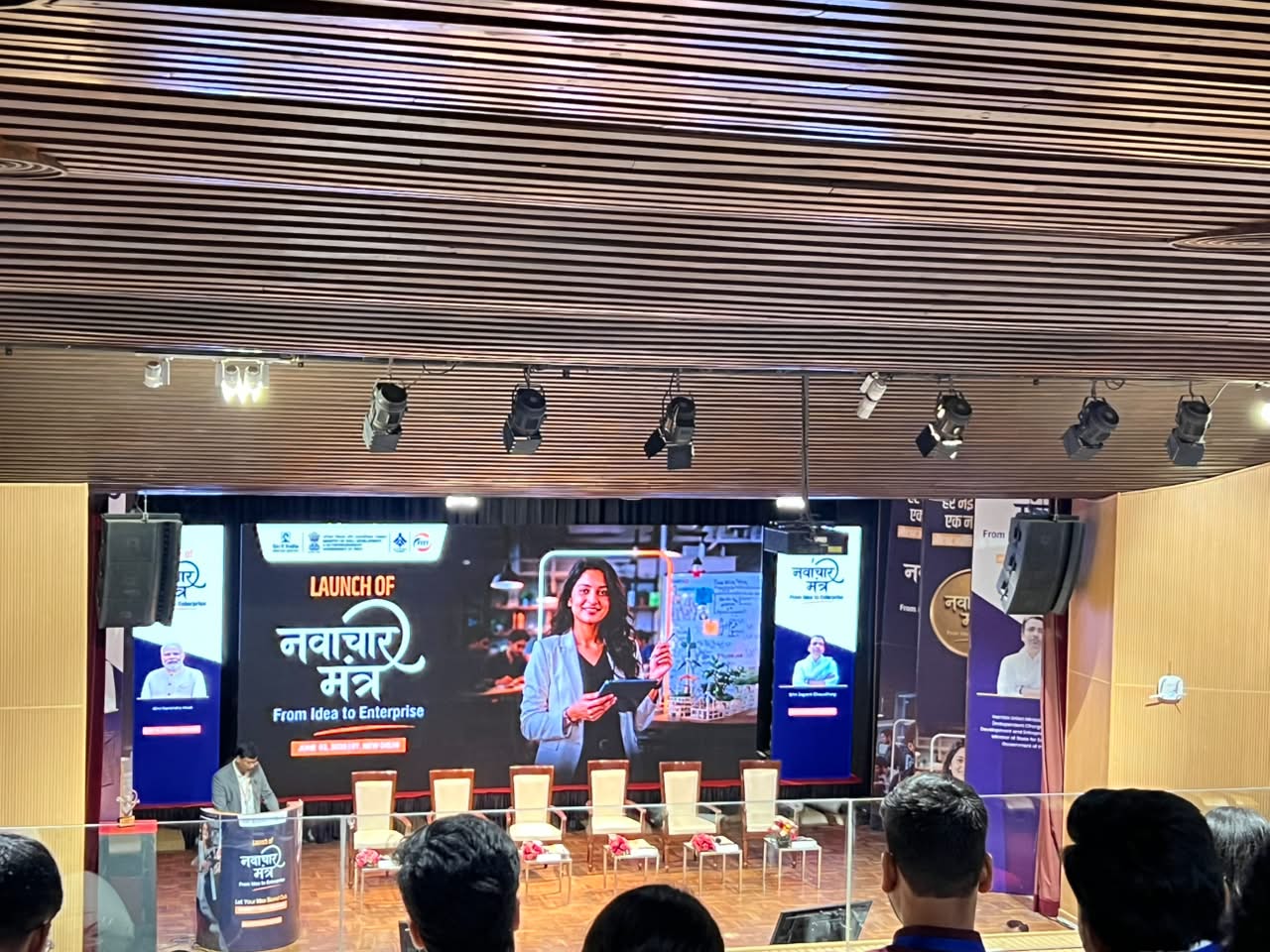
The launch of Navachar Mantra at IIT Delhi on June 3rd was, at least in intent, explicitly about something different.
The programme, launched by the Ministry of Skill Development and Entrepreneurship and implemented by NIESBUD with FITT-IIT Delhi as technical knowledge partner, is designed to find and support innovators from Tier-2 and Tier-3 cities, aspirational districts, and rural regions. People building solutions to problems that do not make it onto the pitch decks that circulate in startup Twitter.
I left the event with more questions than I arrived with. That felt like the right outcome.
What the programme is actually trying to do
It is worth being precise about what Navachar Mantra is, because the word “scheme” in the official name can cause people to mentally file it alongside the long list of government initiatives that announce well and execute quietly into irrelevance.
This one has a specific structure worth paying attention to.
The sectors it targets, Agritech, HealthTech, EdTech, Climate and Sustainability, Rural Commerce, MSME Enablement, are not chosen arbitrarily. They are the sectors where the problems are large, the existing solutions are inadequate, and the people closest to the problem often lack access to the institutional support needed to build at scale. Large problem, weak incumbents, no capital reaching the people who understand it best. That is a description of an underserved market, not only of a social gap.
The mechanism, connecting innovators directly with mentors, investors, policymakers, and domain experts through a multi-stage selection process, is more operational than most government innovation programmes tend to be.
Whether execution matches design is a different question, and one that only time answers. But the intent was stated with more clarity than I usually hear in this context.
The question Minister Chaudhary put on the table
Speaking at the launch, Jayant Chaudhary said something that has stayed with me:
The goal is not just for the world to use products made in India, but to use technologies conceived in India.
That distinction, made versus conceived, is doing a lot of work.
India’s manufacturing ambitions are well-documented. The Make in India framing is familiar to anyone who follows policy. But the deeper ambition, that India becomes a place where original technology is imagined and not merely executed, requires something different from a production incentive. Manufacturing captures margin. Conception captures the asset.
It requires an innovation ecosystem that reaches beyond the campuses and metros that currently define the Indian startup conversation.
Whether Navachar Mantra can do that is genuinely uncertain. But naming the distinction clearly felt like the right place to start.
On academia and startups sharing a room
IIT Delhi as the venue for this launch was not incidental.
FITT, the Foundation for Innovation and Technology Transfer, is one of the more serious institutional mechanisms for moving ideas out of academic research and into the world. Having it as the technical knowledge partner for a programme aimed at grassroots innovators creates an interesting bridge.
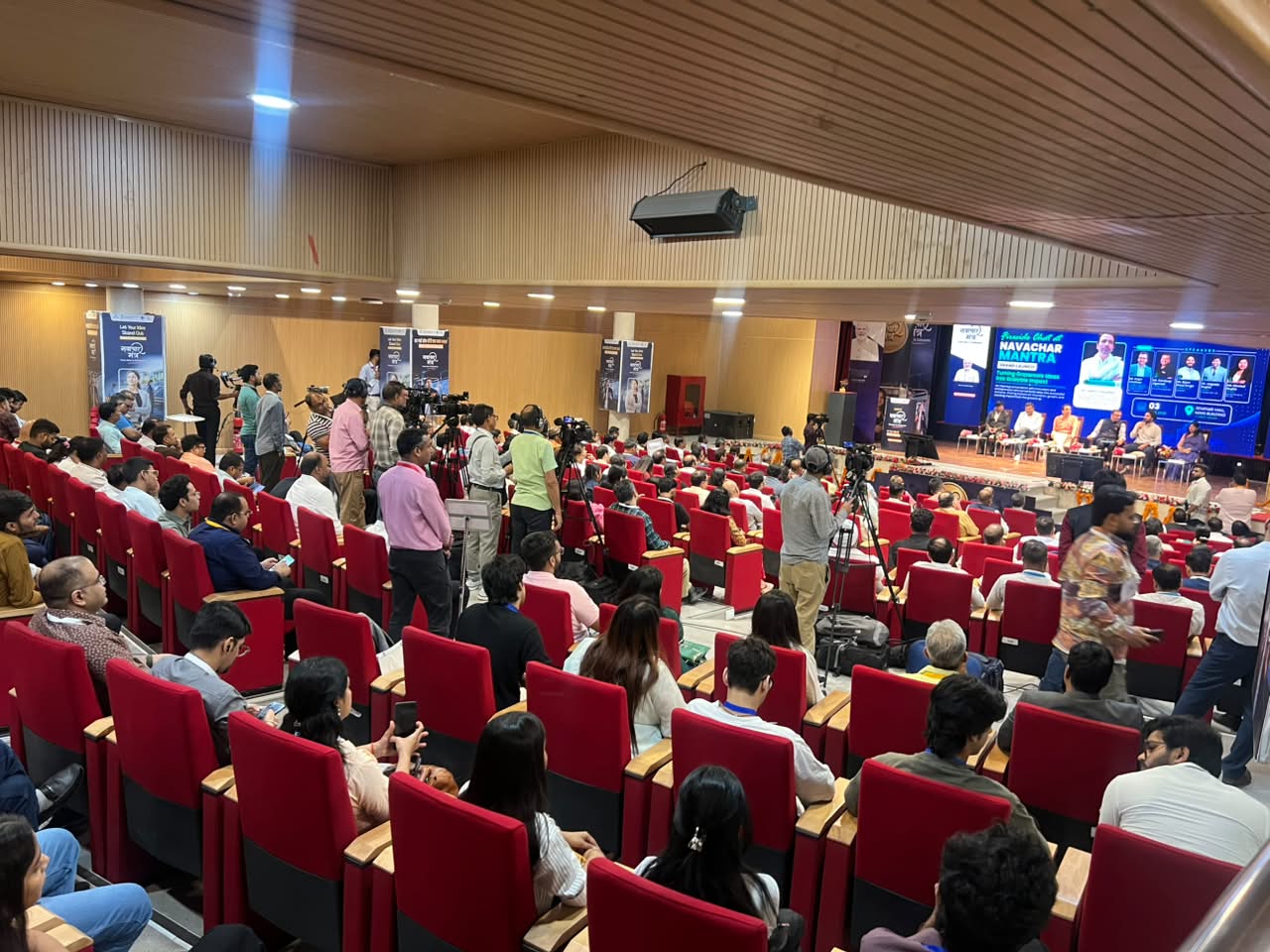
The panel discussions brought together researchers, policymakers, founders, and ecosystem builders in combinations I do not often see at events of this type. The conversations that resulted were more textured than the usual format: less about celebrating what is possible, more about naming what is hard.
What makes early-stage support actually work for founders who are geographically and institutionally disconnected from the mainstream ecosystem? What does mentorship mean when the mentor’s experience is mostly urban and the mentee’s problem is rural? How do you build selection processes that do not inadvertently filter for the kind of polish that comes from already being plugged in?
These questions did not get fully answered. But they were the right ones to be asking in the room.
The people I talked to
The networking at an event like this has a different character from the mixer or sprint contexts I have written about before.
There were more researchers. More people with a long institutional relationship to a particular problem: faculty members who had spent years studying agricultural supply chains, or rural health delivery, or skilling in manufacturing contexts, who were trying to figure out how to translate that knowledge into something that could be supported and scaled.
There were also founders, but founders of a different kind than I usually meet. Less interested in fundraising narrative, more interested in distribution. How do you actually get something to work in a district that does not have reliable internet, or where the end user has never interacted with a digital product before?
These are harder questions than most of the startup conversation engages with. They require a different kind of thinking: slower, more contextual, more willing to be wrong and iterate within a specific geography rather than abstracting up to a general solution.
I found those conversations the best part of the day.
What I am still thinking about
There is a version of the Indian startup ecosystem story that is genuinely impressive: the depth of engineering talent, the scale of digital infrastructure, the number of serious companies being built.
And there is a version of the same story that is more uncomfortable: the vast majority of that activity is concentrated in a few cities, addressing a few demographic segments, within a funding culture that is structurally biased toward ideas that already resemble something that has worked elsewhere. Capital follows patterns, and patterns are cheapest to recognise where they already exist. That is how a whole geography ends up unpriced.
Navachar Mantra is, at some level, an attempt to push against that concentration. To ask whether the innovation ecosystem can extend its reach to the parts of India that have not been well-served by it so far.
Whether it works will depend on execution: on whether the mentorship is substantive, whether the selection process is genuinely meritocratic across geography and background, whether the institutional support translates into real outcomes for the people it is designed to help.
I do not know the answers yet. They will show up in companies that get built, not in the launch. I will be watching for those.
Related: