Om Arora
Researcher · Founder · Investor
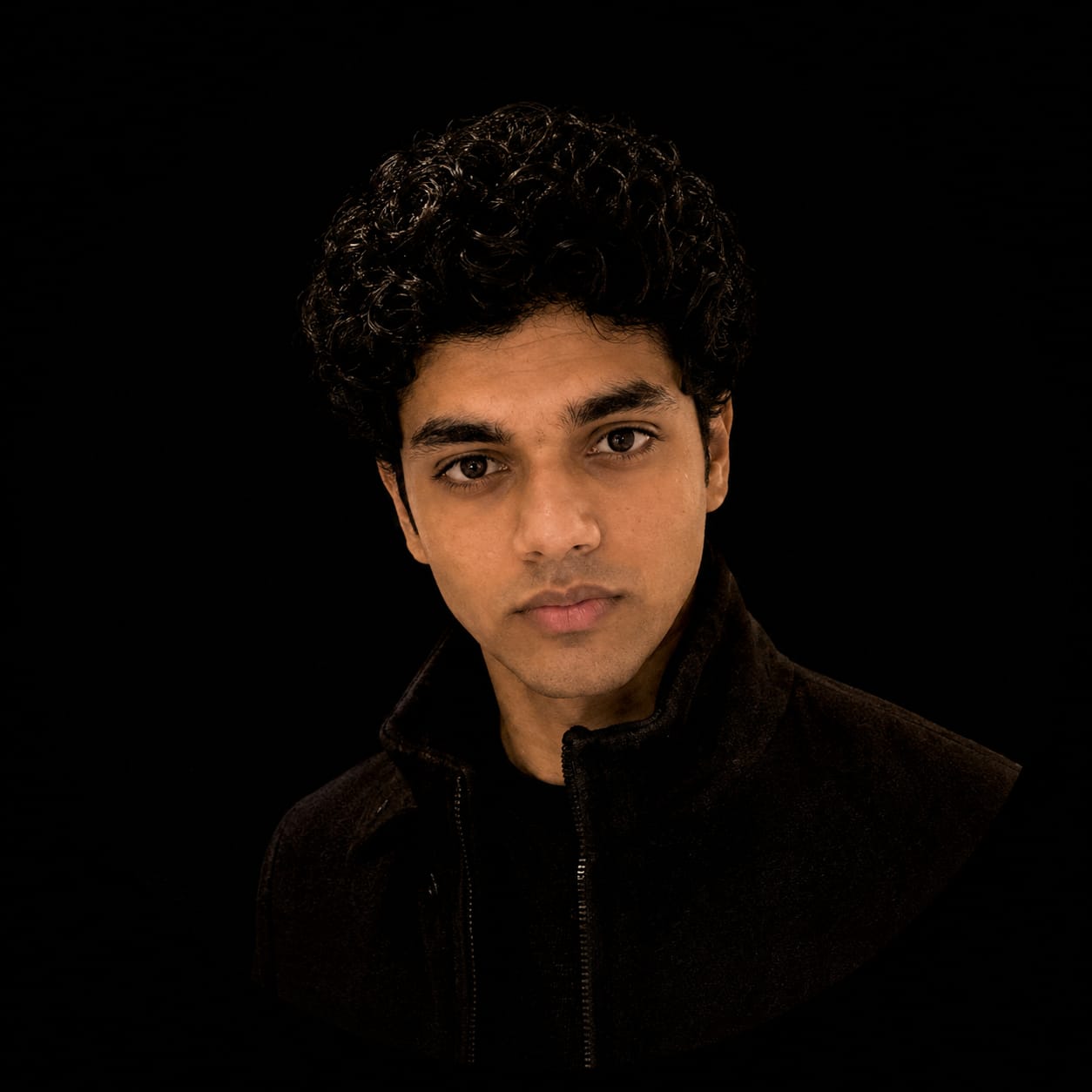
I am a researcher and a founder.
I work across theoretical physics, quantitative finance, and deeptech, spanning gauge theory and the Yang–Mills mass gap, distributed quantum computing architecture, defence systems interoperability, and the topology of financial markets. Five papers published, a company building hard engineering in India, and a research and capital practice alongside it.
The thesis is simple. This country has world-class research talent and almost none of the machinery that turns research into companies, products, or returns. Everyone complains about this. Very few people are building the machinery. I am building the machinery.
What I actually do, on both sides, is price things. Some of them are gauge fields and some of them are companies. The discipline is closer than either camp likes to admit: state the claim, find the thing that would break it, and do not believe yourself until you have tried.
Outside the work: Dostoevsky and Tolstoy, Bach and Shostakovich, the history of empires, and the satisfaction of an elegant proof.
How this happened
Some of the systems work came out of time spent working in industry as an engineer on defence systems rather than out of a paper. That is why the interoperability problem was obvious to me, and why I treat shipping as a research constraint instead of an afterthought.
Research
Yang–Mills and gauge-invariant mass generation. An extension via a group-valued Stueckelberg field, with full BRST quantisation and asymptotic freedom intact. Current work is the two-loop structure, the Gribov problem, and a statement that survives beyond perturbation theory.
Quantum gravity. QGET treats entanglement correlations as the structure from which spacetime emerges. Open threads: the classical limit, the correspondence with loop quantum gravity, and black hole information.
Distributed quantum computing. DQERA, built on entanglement routing. Useful quantum computation will not arrive as one large machine but as many small ones sharing entanglement across a lossy network, which makes routing and scheduling the real bottleneck.
Systems and protocol architecture. A software-defined, protocol-agnostic translation layer between MIL-STD-1553B and STANAG 4586 that collapses N×(N−1) integration into 2N, with no dependency on Western proprietary hardware.
Quantitative research. Stochastic calculus on limit order book dynamics, and persistent homology as a lens on regime transition. A strategy has to be mathematically rigorous before it is deployed, even when it makes money without that.
AI for mathematics. Formal proof generation. Verified symbolic reasoning at olympiad level.
Building
Four bets, described here rather than named. Some of them have names. They are not on this site yet.
A deeptech company. Founded to build hard engineering in India instead of importing it, across space, defence systems, electronics, artificial intelligence, and robotics. One spine runs through all five: each attacks a place where India buys a capability it is fully capable of owning, and where the thing bought is software or architecture rather than anything needing a billion dollar plant. Buy the hard asset when it is genuinely hard to build. Never rent the part you could have owned.
A practice for the startup ecosystem. I have seen the ecosystem from the technical side and the capital side, and the same two failures repeat. Companies with real technology and no research function. Capital that cannot evaluate what it is buying. So the practice delivers research and development as a service, and investment consulting, which I do personally.
An operating system for researchers, and an experiment in what research is worth. Literature, data, experiment records, drafts, versions, collaborators, and funding live in tools that know nothing about each other, and the cost of holding them together falls on the researcher. I am building the layer that should already exist.
There is a second thing I am testing through it, and it is the reason I am building the first. Research has no price until it becomes a patent or a product, so the years in between are funded by grants, goodwill, or nothing, and whoever did the work rarely captures the upside. I do not think that is a fact of life. I think it is a pricing failure, and pricing failures are the kind of thing you can build a mechanism against. The full shape of that goes public when the product does.
A society for scientific outreach. STEM promotion in India involving contact with actual researchers rather than with the idea of them. Guest lectures, Indian researchers put in front of students who would otherwise never meet one, and international olympiads. It makes no money and is not supposed to.
None of this is charity. It is the observation that the return on fixing the machinery is larger than the return on anything built on top of it, and that almost nobody is pricing it that way.
Publications
A Gauge-Invariant Stueckelberg Extension of Yang–Mills Theory (2025) · DOI
A Software-Defined Protocol Translation Architecture for Multi-Domain Defence Asset Integration (2026) · DOI
Physics of Market Regimes and Microstructure: Formalisms, Empirics, and Quantitative Applications (2026) · DOI
Quantum Geometric Entanglement: A Unified Model for Emergence of Spacetime in Quantum Gravity (2023, IJRES) · DOI
Yang-Mills Theory with a Scalar Field: A Unified Model for Confinement and Mass Gap (2023, IJRES) · DOI
The long version of the physics, including what each paper does not do, is here. What I am working on this month is here.
Interests
Theoretical Physics · Quantitative Finance · Mathematics · Gauge Theory · Quantum Gravity · Quantum Computing · TDA
Philosophy · Classical Music · Astronomy · History · Literature · Art
Some ventures take years to become legible. I am comfortable with that, and I am not waiting on permission.
Recent writing
- 2026-08-19 What Happens to the Kid Who Places 400th
- 2026-08-14 Why Interoperability Is the Least Glamorous Problem in Defence
- 2026-08-09 The Honest State of Quantum Computing in 2026
- 2026-08-05 The Distance Between Seeing and Acting
- 2026-07-31 India Has Simulation Users and No Simulation Builders
- 2026-07-27 Peer Review Is Unpaid, Invisible, and Nobody Is Measuring It